Survey is the most widely used technique in social science to gather data. There are different types of surveys —phone interviews, internet opinion polls, and variety in the types of questionnaires. They are all based on the ideals of the professionalized social research survey. Although there are those who claim that they will conduct a survey to acquire information, what they should actually have said is that they need the most suitable way to acquire good data.
Surveys are very useful in that they provide us with accurate, reliable, and valid data. However, getting these benefits requires serious effort and thought. For instance, the fact that the general public are familiar with the survey technique and that it is easy to conduct a survey can be a drawback. Even though surveys are widely used and popular, a sloppy survey can easily produce misleading results.
Survey research developed within a positivist approach to social science. Surveys yield information that is inherently relevant for statistical analysis. The questions in most surveys target a large number of people (known as respondents), who are asked about their beliefs, opinions, characteristics, and past or present behaviors. Therefore, surveys are appropriate for learning about self-reported beliefs or behaviors. Most surveys ask series of questions at once, thereby measuring many variables. Because of this, the gathering of descriptive information and testing of multiple hypotheses in a single survey are possible.
Surveys can be used for exploratory, descriptive, or explanatory research. However, caution is required when asking “why” questions of respondents. While it may well be true that,from such questions, one can learn about people’s beliefs and subjective understandings, people often tend to have incomplete, mistaken, or distorted views. We should not mistake what people say or believe about why things occur for actual cause-effect relations in the social world.
In experimental research, on the one hand, small numbers of people are divided into equivalent groups, one or two hypotheses are tested, conditions are manipulated so that some participants get the treatment, and the setting is under close supervision to minimize threats to internal validity (i.e., confounding variables). At the end of an experiment, there is a quantitative data, wherein participant responses on the dependent variable can be compared.
On the other hand, survey research relies on a different logic. Many respondents are usually sampled and all of them are asked the same questions. Many variables are measured with the questions and multiple hypotheses are tested simultaneously. Temporal order from questions about past behavior, experiences, or characteristics are inferred. The associations among the variables are statistically analyzed to identify causal relationships.
It is also important to consider alternative explanation and measure them with other survey questions (i.e. control variables). They are also included in the statistical model to rule out their effects. Surveys are sometimes referred to as correlational because the researchers are not controlling and manipulating conditions as in an experiment. In survey research, control variables are used to statistically approximate an experimenter’s physical controls on confounding variables.
Survey research proceeds deductively. First, one conceptualizes variables and then operationalizes each variable as one or more survey questions. Here is an overview of question types in survey research:
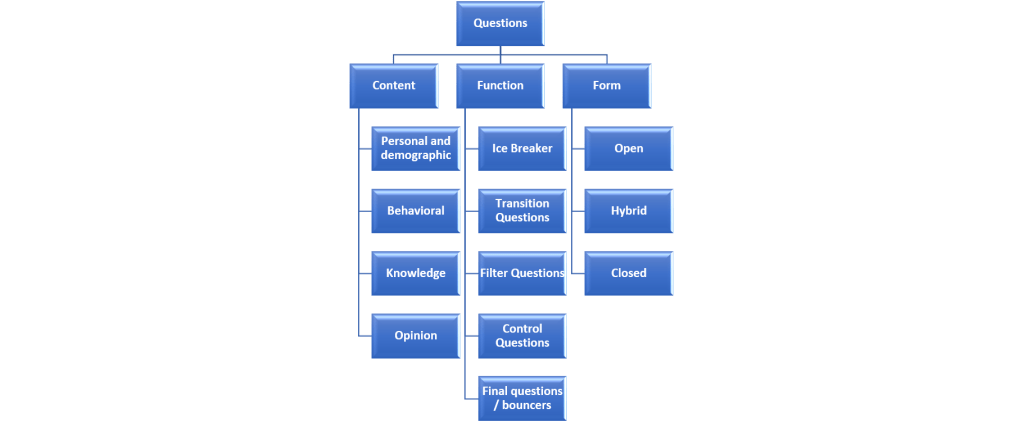
Each question type has its advantages and disadvantages. In the case study below, I will carry out a descriptive analysis using content question (personal and demographic, as well as opinion questions) and closed formed questions of Afrobarometer Survey data.
Case study
Genuine, inclusive, free and fair elections are an integral part of democratic governance. They provide the platform for eligible voters to determine their representatives at the local, district and national level. But what do West African citizens think about the quality of elections in their country?
At least two-third of citizens in Mali, Niger, and Senegal perceive elections in their country to be completely free and fair!
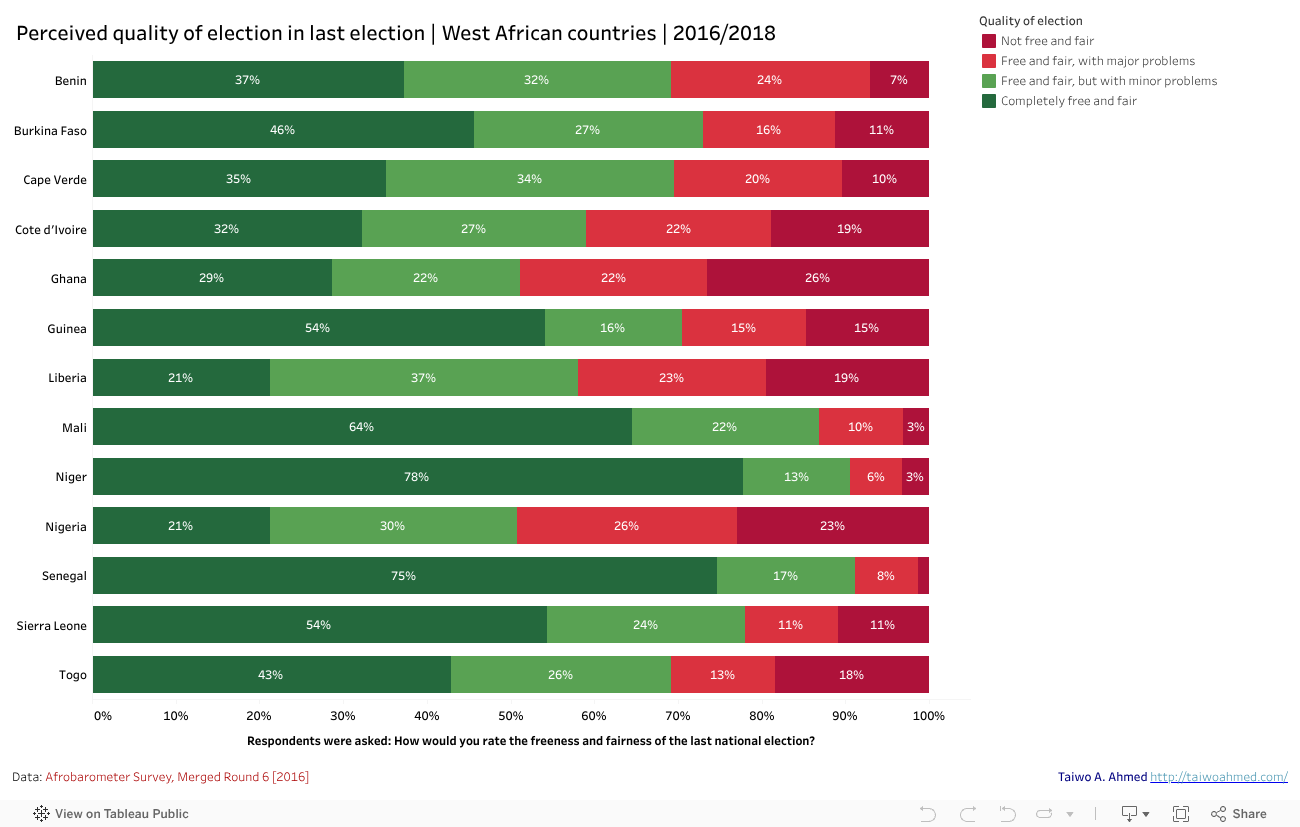
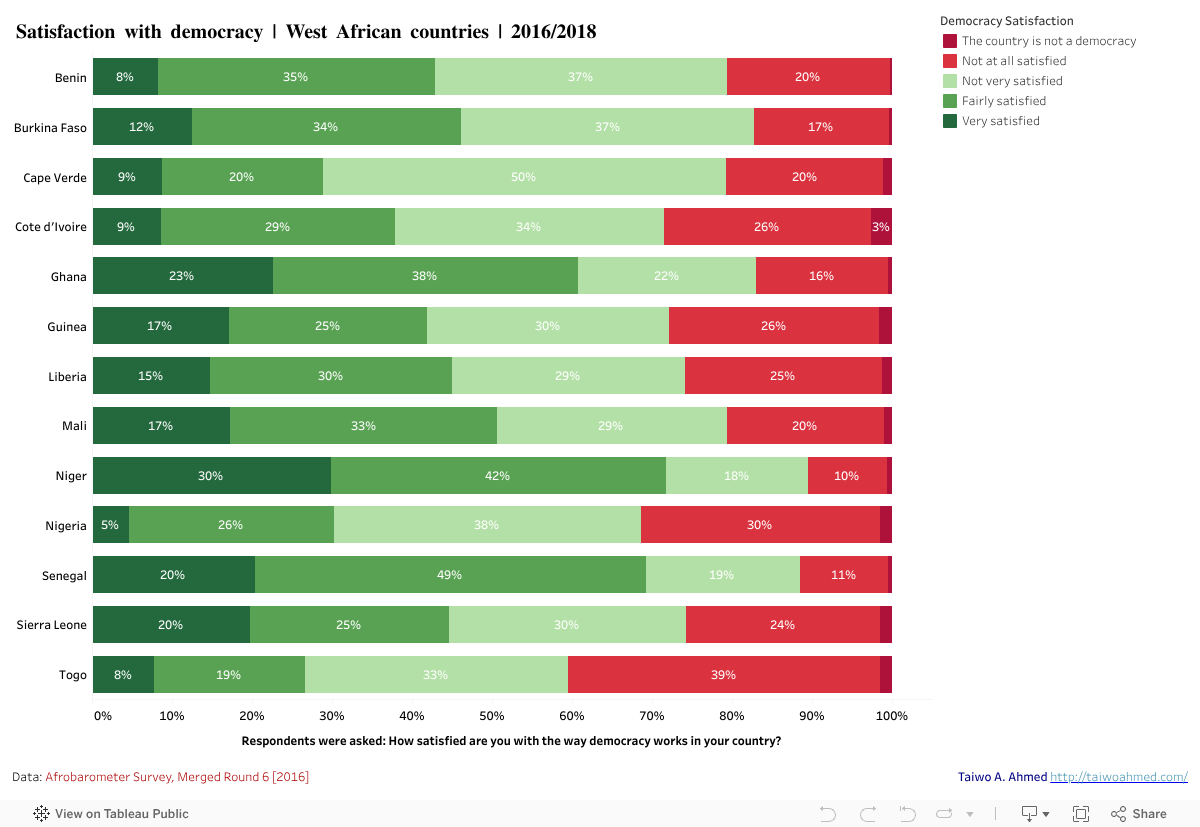
Even when the process is free and transparent, elections can be inhibited by underrepresentation. Furthermore, discrimination based on gender, economic inequality are major obstacles that inhibit respect for human rights in an electoral context. The limited participation by a group in elections will likely result in the group’s under-representation in the making of policies and legislations. This can undermine the group’s ability to protect and promote its interests. Therefore, I examine how satisfied citizens are, in general, with how democracy works in their country.
In the top three West African countries with self-perception of completely free and fair election, more than half of the citizens are satisifed with the way democracy works.
Institutions should be democratic and representative of all groups in society – regardless of gender, group size composition, material wealth. Since women are still underrepresented in politics in some parts of the world, let’s see if the satisfaction with democracy differ by gender in the top three West African countries with self-perception of completely free and fair election.
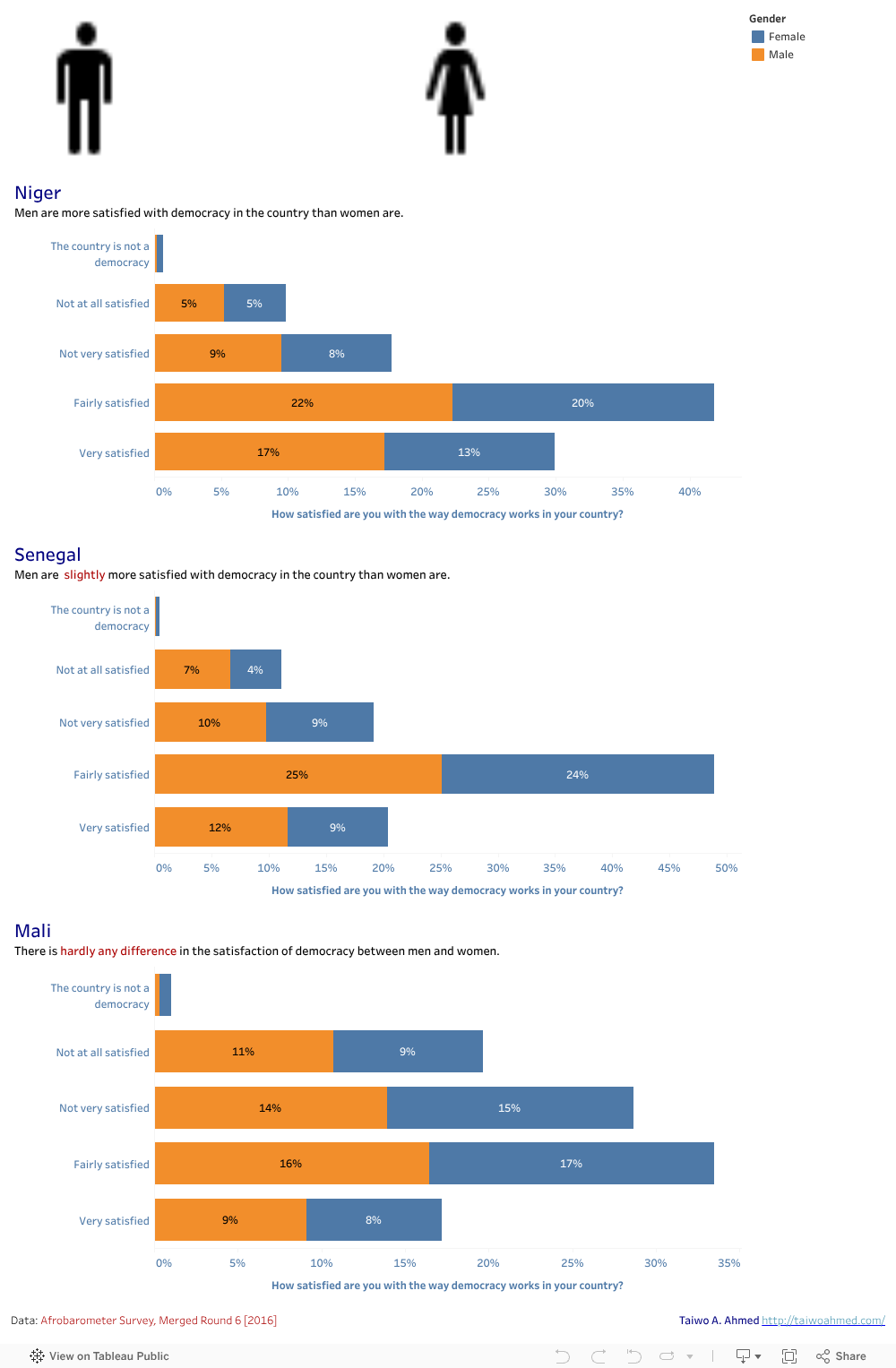
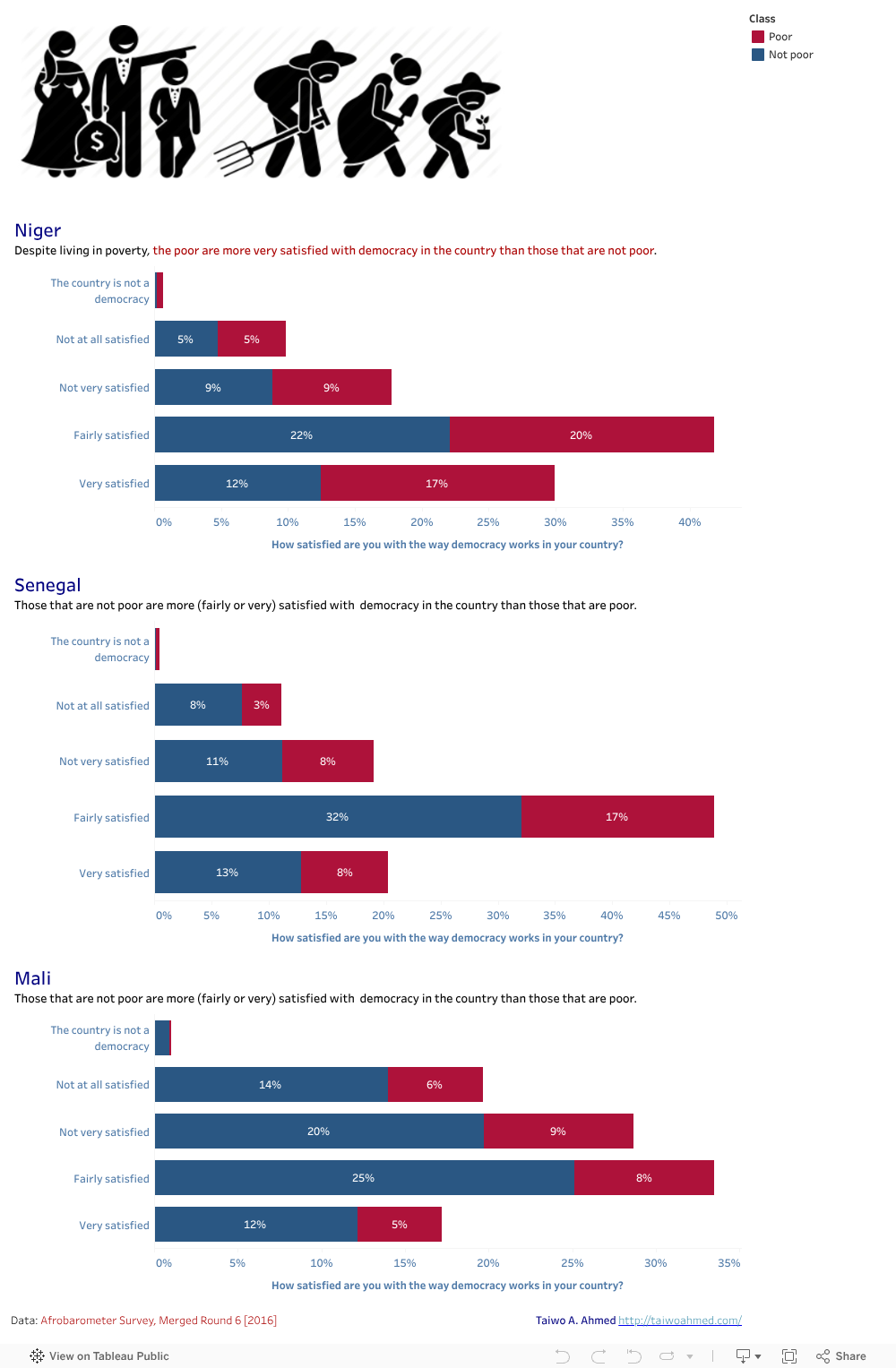
But does being affluent or dispossessed influences one’s satisfaction with democracy in one’s country?
Conclusion
At least two-third of citizens in Mali, Niger, and Senegal perceive elections in their country to be completely free and fair. More than half of the citzens in these countries are satisifed with the way democracy works in their country. These are, however, just the numbers themselves. It would be much more insightful to do a statistical test to see if the numbers are different from each other in reality.
One challenge to be encountered with opinion questions in survey, however, is the issue of non-opinions. This means that interview candidates start thinking about the task exactly when they are confronted with the question. This can lead to pseudo-opinion. Besides that, respondents may substantially change answers after minimal changes in how the question is formulated. They may also be untruthful in their answers due to social expectancies.
References
I learnt about survey research from chapter 10 of Lawrence Neuman’s book and chapter 7 of Zikmund’s and Babin’s book.


 Taiwo A. Ahmed